Your ISMS contains your most valuable information
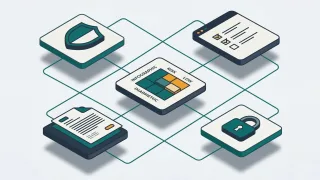
An ISMS systematically documents where your organization is vulnerable. Risk analyses, vulnerability assessments, action plans, incident reports, network diagrams, access concepts — these are the crown jewels of your IT security. And you upload precisely this information to a SaaS platform running on servers over which you have zero control? That deserves a second look.
Cloud-based compliance tools are convenient. No server setup, no update overhead, ready to go immediately. But this convenience comes at a price that rarely appears on the glossy landing pages: you hand over sovereignty over your most sensitive data to a third party.
The Cloud Act and the control problem
If your ISMS provider is headquartered in the USA or uses American cloud infrastructure, the US CLOUD Act applies. This law compels American companies to hand over data upon request from US authorities — even when the servers are physically located in the EU. Following the CJEU's Schrems II rulings, the legal situation is clear: an adequate level of data protection for personal data in the USA is not guaranteed. For risk analyses and security documentation that go far beyond personal data, this applies even more so.
This is not a theoretical risk. For a company that is pursuing ISO 27001 certification or needs to meet NIS2 requirements, the question "Where is our ISMS data stored?" is one that every auditor will ask. And "on the servers of a US provider" is an answer that generates follow-up questions.
Vendor lock-in: the silent loss of control
Data sovereignty does not end with the question of which country the server is in. Equally decisive is whether you can fully export your data at any time and migrate to another system. Many SaaS platforms make entry easy and exit hard. Proprietary data formats, limited export functions, no documented API — all of this ties you to a provider, whether you want it or not.
Imagine your ISMS provider gets acquired, doubles its prices or shuts down operations. If your risk assessments, measures and audit records are stuck in a format that only this one platform can read, you have a serious problem — at precisely the moment when you can least afford one.
What self-hosting really costs
The most common argument against self-hosting is: "Too expensive, too much effort." That was true ten years ago. Today the calculation looks different. A managed server from a German hosting provider costs between 20 and 50 euros per month. Docker containers make deployment predictable and repeatable. Updates run via a single command. The actual administration overhead for a self-hosted application is just a few hours per month.
Compare that with typical SaaS costs for ISMS software: 300 to 800 euros per month depending on user count and feature scope. Over three years, that adds up to 10,000 to 30,000 euros. ISMS Lite costs 500 euros per year as a subscription or 2,500 euros as a one-time purchase for the self-hosted version. Your data lives on your server, in your network, under your control.
Data sovereignty is not a luxury
Self-hosting is not old-fashioned or backward-looking. It is the consistent application of the same principle you preach in your ISMS: control your critical assets. Minimize dependencies on third parties. Know your attack surface. If you tell your customers they need to protect their data, start with your own compliance software.
This topic page brings together our articles on data sovereignty, self-hosting and practical implementation. From the legal classification of the Cloud Act through the TCO comparison between SaaS and self-hosted to the concrete Docker guide for your own ISMS — each article gives you the knowledge and tools to make an informed decision about where your most sensitive data should reside.